> For the complete documentation index, see [llms.txt](https://j-kawai0908s-organization.gitbook.io/value-decentralization-whitepaper/llms.txt). Markdown versions of documentation pages are available by appending `.md` to page URLs; this page is available as [Markdown](https://j-kawai0908s-organization.gitbook.io/value-decentralization-whitepaper/present-demonstrations/05-ethereum-ecosystem.md).
# 5. Ethereum and the Evidence Boundary
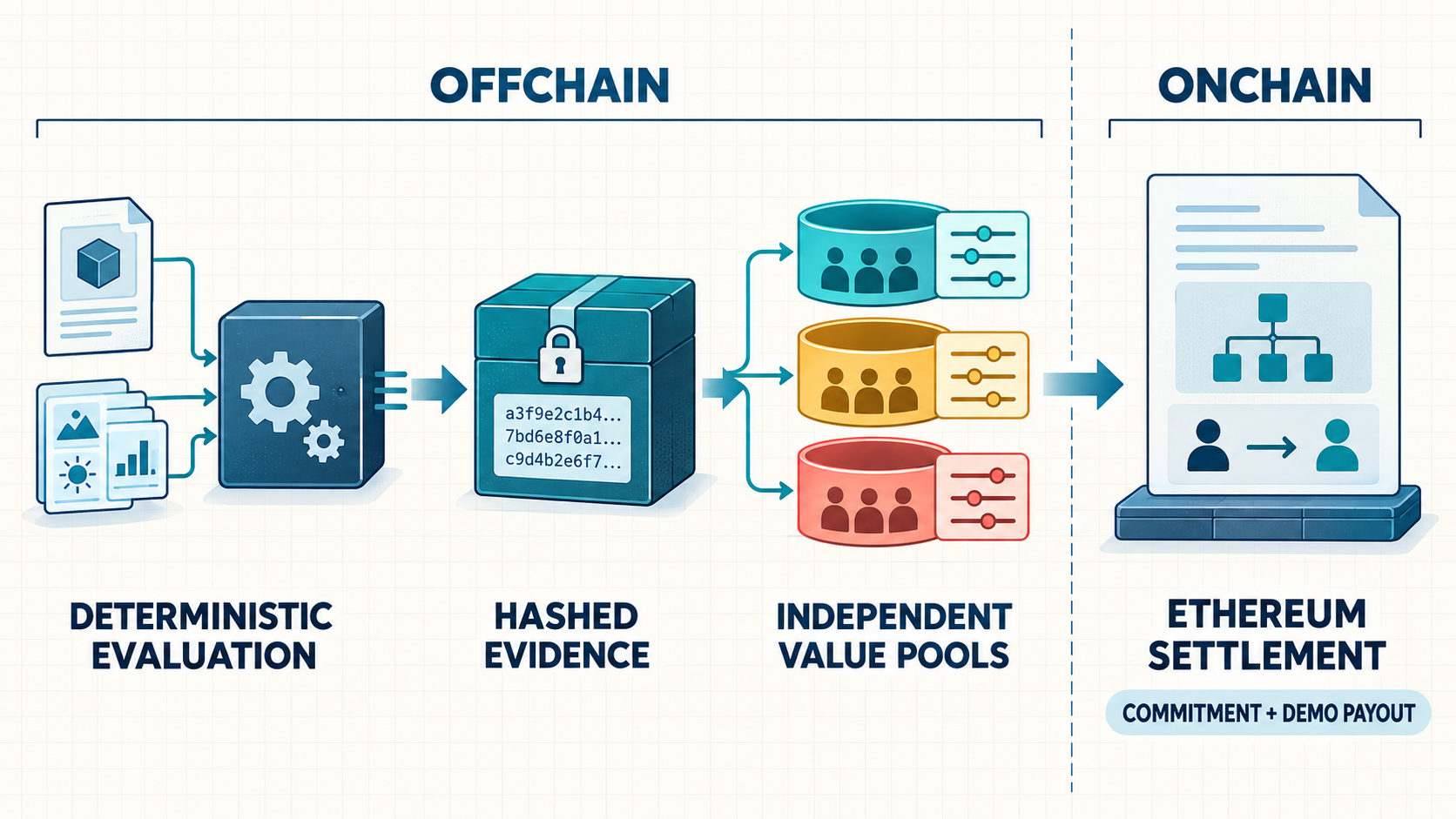
Ethereum is not the evaluator in Value Decentralization. The blockchain does not make an offchain calculation correct by itself. Its role is to make the selected result and final allocation difficult to rewrite after the fact, while allowing anyone to inspect the reward event.
Offchain evaluation and onchain settlement
## 5.1 Why evaluation is offchain
Arena-specific evaluation may require simulating seven disaster scenarios, compiling Solidity, or executing EVM runtime bytecode. Performing every step onchain would be expensive and would make it difficult to adapt the system to new problem shapes.
To preserve reproducibility while computing offchain, the system versions its inputs, datasets, constraints, metrics, evaluator, and outcomes, and links them through hashes.
## 5.2 Why settlement is on Ethereum
| Offchain | Onchain |
| ------------------------------------------ | ------------------------------------------------------------------------- |
| Artifact intake | Allocation commitment |
| Constraint checks | Reward-pool balance constraints |
| Scenario evaluation | One commitment per challenge |
| Outcome Vector | Prevention of duplicate rewards to the same wallet for the same challenge |
| Pareto and Contribution calculation | RewardPaid event |
| Allocation calculation for each Value Pool | Individual claim path for participants skipped during batch distribution |
Ethereum protects the commitment and payment boundary outside the evaluator.
## 5.3 Evidence Chain
```
dataset + evaluator + constraints + metrics
→ context hash
context hash + artifact + measurements
→ result hash
final results + value-pool calculations
→ allocation root
allocation root + reward transfer
→ Sepolia transactions and events
```
Changing the dataset, constraints, metrics, or evaluator settings changes the Context Hash. Changing an outcome or allocation changes the corresponding Result or Allocation Evidence.
## 5.4 Current Reward Demonstration
The current settlement demonstration uses two primary contracts.
| Contract | Current role |
| -------------------- | ---------------------------------------------------------- |
| `FrontierRewardPool` | Allocation commitment, distribution, and individual claims |
| `FrontierDemoToken` | Demonstration token on Sepolia |
“Frontier” in these contract identifiers is a historical implementation name, not the name of the product.
Public evidence:
* [Allocation commitment](https://sepolia.etherscan.io/tx/0x96fd7a9d1f4a3bbd2fa7a9ea28d250a16e8eedbaff05b51a4f33e581c3839f2c)
* [RewardPaid transaction](https://sepolia.etherscan.io/tx/0xd976a968aefeb66d7e60fba7a9cf64c8711195fc3652aeccc20c7448069ad708)
In this demonstration, the recipient balance increased by 10,000 FDT. FDT is a Sepolia demonstration token and carries no claim of monetary value.
{% hint style="warning" %}
The public evaluators and Sepolia reward demonstration both have real evidence, but they are not yet integrated into a complete production tournament.
{% endhint %}
## 5.5 Design explorations for Ethereum engineering
The shared vocabulary of Value Decentralization could also be applied to the following technical domains. These are research directions, not a list of currently implemented arenas.
| Domain | Independent outcomes | Hard Constraint |
| --------------------------- | -------------------------------------- | ---------------------------------------- |
| Home Proving | proving latency, energy, hardware cost | proof validity, security |
| Post-Quantum Authentication | verification gas, signature bytes | post-quantum security, replay protection |
| Confidential Compute | encrypted latency, state overhead | correctness, privacy |
| Data Availability | throughput, per-node bandwidth | recovery guarantee |
| Verified Optimization | runtime gas, bytecode size, proof cost | formal equivalence |
| Accountable RPC | response latency, privacy overhead | response correctness |
The research question is whether different Value Pools can support these outcomes independently, rather than forcing every engineering goal into one KPI.
---
# Agent Instructions
This documentation is published with GitBook. GitBook is the documentation platform designed so that both humans and AI agents can read, navigate, and reason over technical content effectively. Learn more at gitbook.com.
## Querying This Documentation
If you need additional information that is not directly available in this page, you can query the documentation by asking a question.
Perform an HTTP GET request on the following URL with the `ask` and `goal` query parameters:
```
GET https://j-kawai0908s-organization.gitbook.io/value-decentralization-whitepaper/present-demonstrations/05-ethereum-ecosystem.md?ask=&goal=
```
`ask` is the immediate question: it should be specific, self-contained, and written in natural language.
`goal` is what the user is ultimately trying to achieve, the reason they need the answer. Sharing it helps GitBook give you a better, more relevant answer. A goal is most helpful when it describes the outcome the user wants rather than restating the question. For example, with `ask=how do I create an API token`, a goal like `automate deployments from our CI pipeline` lets GitBook tailor the answer to that use case.
The response will contain a direct answer to the question and relevant excerpts and sources from the documentation.
Use this mechanism when the answer is not explicitly present in the current page, you need clarification or additional context, or you want to retrieve related documentation sections.